The score for Paul Thomas Anderson’s 2002 film Punch-Drunk Love is widely considered a landmark work in modern film scoring. Composer Jon Brion created a soundscape that is simultaneously beautiful, frantic, chaotic, and deeply romantic, reflecting the psychological state of the film’s protagonist, Barry Egan (Adam Sandler).
Listen
Original theme studio recording
The central melody of the film is found in the track “Here We Go,” which plays over the end credits. This motif is woven throughout the entire score, acting as the foundation for Barry and Lena’s emerging love story.
The score is structured around two distinct sound worlds: the tense, percussive “noise” tracks representing Barry’s anxiety and the beautiful orchestral waltzes representing his love for Lena. According to Jon Brion:
“The chaotic stuff is Barry’s interior life.”
Live performance by Jon Brion
Jon Brion and orchestra play “Here We Go” from Punch-Drunk Love at the live screening at The Theatre at Ace Hotel on Saturday, March 5, 2016.
During this performance, both JB and PTA have reportedly forgotten what was actual music and what was sound effects.
Fan cover: “Here We Go”
Play it yourself
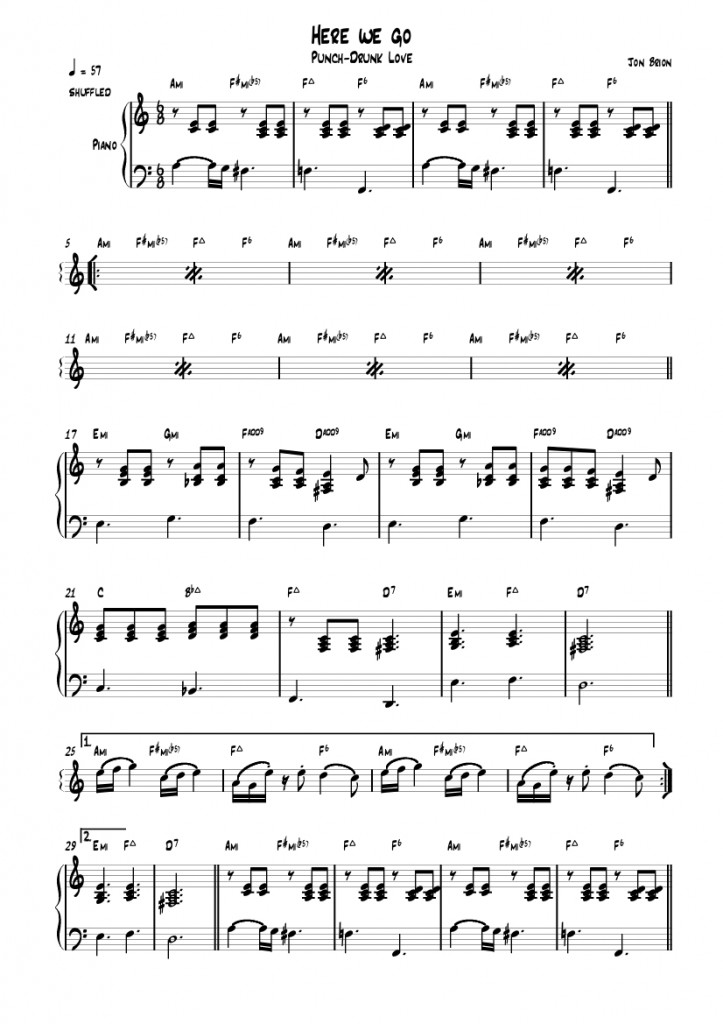
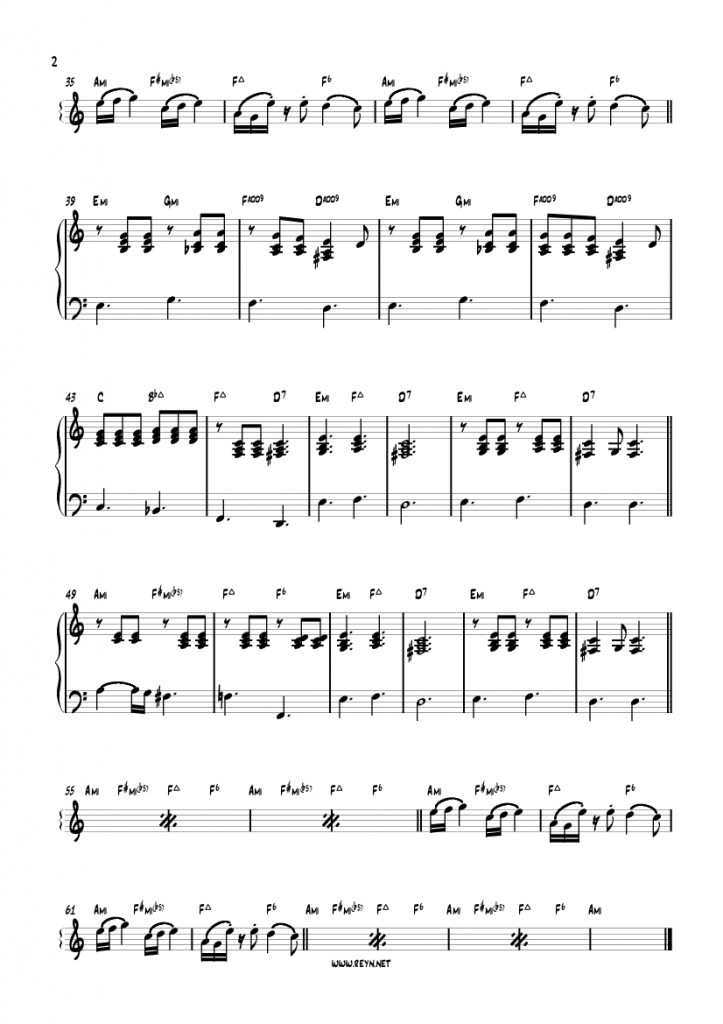
Sheet music
The score features several iconic themes popular among musicians.
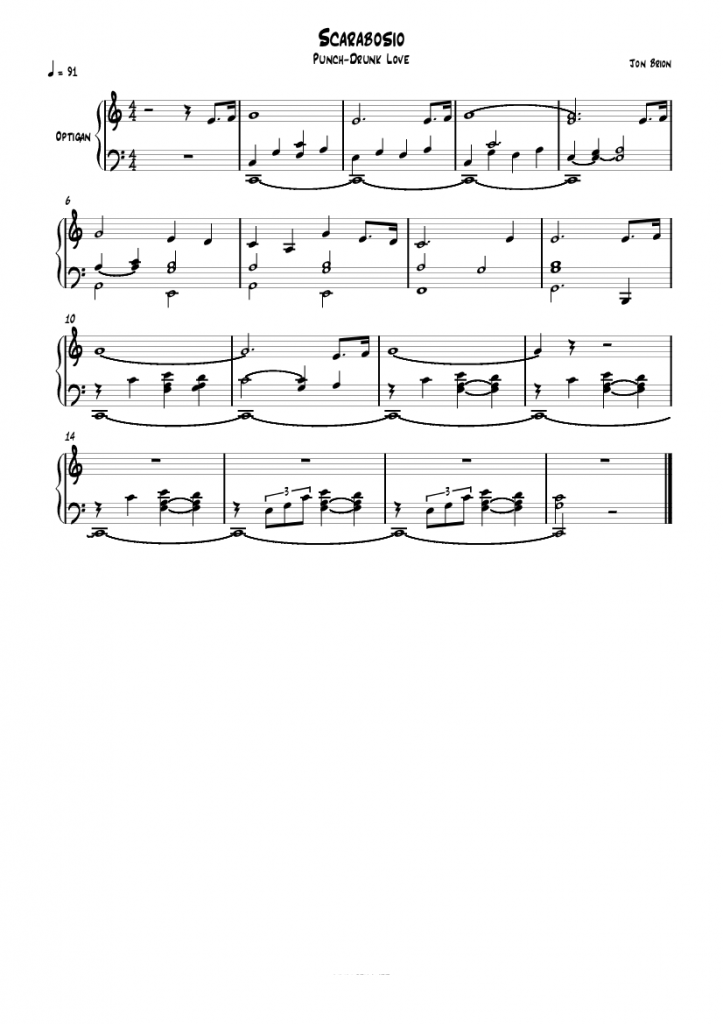
When searching for sheet music, look for the title track “Here We Go,” as its melody is the film’s signature motif.
About this soundtrack by Jon Brion
How the Punch-Drunk Love soundtrack was created
Jon Brion’s collaboration with director Paul Thomas Anderson on Punch-Drunk Love was unique for its improvisational, in-the-moment nature.
Brion worked simultaneously with Paul Thomas Anderson as the film was being shot, rather than scoring a finished rough cut, allowing the music to deeply evolve with the narrative.
Anderson approached Brion early and asked him to create rhythms for the long takes while prepping the film, long before melodic writing was involved. Jon Brion remembers:
“I created a set of rhythm tracks, heavily percussive stuff, to give to Paul and Adam Sandler (who plays the film’s cracked, self-doubting hero, Barry Egan) so they could get an idea of the movie’s soundscape while shooting.”
As a result, the entire shooting was orchestrated to Jon Brion’s initial rhythms — and the influence of his music on the film didn’t stop there. Brion’s workspace was 20 feet away from Anderson’s, and they were constantly around each other, working together in a way other film composers told Brion was completely unique.
As such, Anderson beatboxed specific rhythms into his microcassette recorder for Brion to use for particular scenes.
Brion, in the meantime, created long rhythmic tracks and sound bites that worked with the musical pieces — essentially sound effects in time with the beat that consciously worked with the orchestra. They even harmonized the score with a single creak from a passing truck in one scene.
Recording sessions of the Punch-Drunk Love soundtrack were conducted throughout editing at Abbey Road Studios, using vintage RCA mics, prepared piano and multiple orchestras, inspired by old MGM musicals that Anderson loved.
Watch a Jon Brion interview on the rhythms of Punch-Drunk Love
“A musical where no one breaks into song”
Brion once said to Anderson: “I think what you actually want is the thing to feel like a musical, but nobody ever breaks into song,” to which Anderson replied “Exactly!”
Watch a Jon Brion interview on Punch-Drunk Love and the Hollywood musical
Instruments & Sounds
The distinctive, slightly out-of-tune sound prominent in tracks like “Punchy Tack Piano” comes from a tack piano, which is a regular piano modified with tacks or nails in the hammer felts for a bright, percussive effect.
Instead of a drumset or traditional percussion, Brion used prepared piano — sticking various objects into a grand piano to stunt notes from ringing out, creating rhythms that were simultaneously percussive and just ever so slightly melodic. The techniques for prepared piano come from John Cage, the late father of the American avant-garde and the primary influence for the Punch-Drunk Love soundtrack.
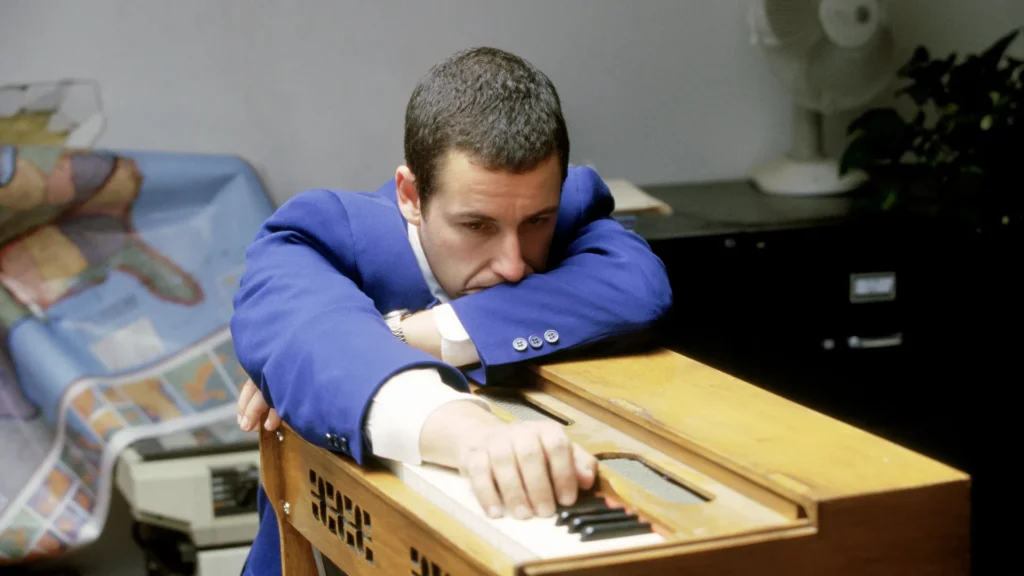
The harmonium is also a significant instrument, visually linked to Barry and musically central to the score’s emerging romantic themes. Ironically, yon won’t hear harmonium on the soundtrack once. Instead, Brion and drummer Jim Keltner used a dreidel with air vents and two slightly out-of-tune chords — when spun, it created a Doppler effect with vibrato, producing a “wheezing, harmonica-with-asthma sound.”
The score’s alternating themes, described as “destructured music,” actively “explode the interior of the shots” and “dictate the pace of movements,” creating an atmosphere of “conceptual tintinnabulation” or noise.
Many of the jarring, percussive sounds were not traditional orchestral instruments but elements recorded directly from the warehouse set where Barry works, literally using his environment to create his inner tension.
Borrowed songs
The album famously includes two songs not composed by Jon Brion, which are crucial to the film’s quirky, musical narrative:
“He Needs Me” (sung by Shelley Duvall)
This track is an original song from the 1980 film Popeye (directed by Robert Altman). Its inclusion by Paul Thomas Anderson adds a layer of whimsical, simple sincerity to Barry and Lena’s relationship. The team got the old masters of that song, then overdubbed the orchestra playing that melody in a variety of different styles, so Anderson had it at his fingertips for any given moment.
“Danny (Lonely Blue Boy)” (performed by Conway Twitty)
This 1960 country hit provides a stark, traditional contrast to Brion’s abstract, modern score, further emphasizing Barry’s loneliness and inner turmoil before he finds Lena.
Cultural impact & legacy
After being unable to use the harmonium in Punch-Drunk Love (2022), Brion filled his next two scores — I Heart Huckabees and Eternal Sunshine of the Spotless Mind (both 2004) — with harmoniums, making up for lost time.