If Aimee Mann was the foundation of the Jon Brion sound, Fiona Apple was its explosive, maximalist realization. Their collaboration represents a rare moment in music history where a producer’s eccentric genius perfectly matched an artist’s raw, uncompromising emotional depth. Together, they moved away from the “sullen girl with a piano” trope of the mid-90s and into a world of jazz-inflected, percussive, and cinematic brilliance.
“He’s the only person who I feel like I can play a song for and he’ll know exactly what I want to hear.”
Fiona Apple on Jon Brion
“Fiona is deeply incredible. Just really, really good. It was a pleasure every day to work on the material. She is a total dream to work with. She is the easiest, nicest, most considerate, most forthright person I have ever worked with in a production capacity. No one even comes close.”
Jon Brion on Fiona Apple
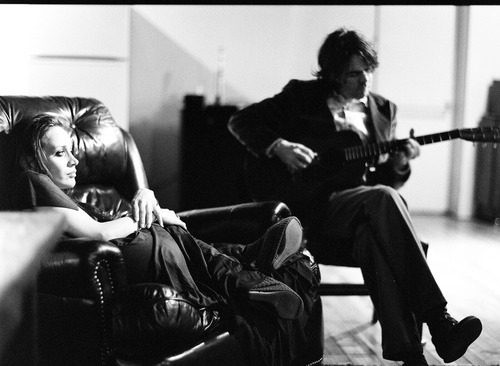
This wasn’t an easy partnership. But it was a formative one — and for many fans, still the most fascinating chapter in Fiona Apple’s recorded work.
Key albums
- When the Pawn… (1999) – The masterpiece that proved both artists
- Extraordinary Machine: Jon Brion Sessions (2003, unreleased) – The legendary lost album
- Extraordinary Machine (2005) – The official release, partially re-recorded
Essential tracks
- “Fast As You Can” – Volcanic intensity meets precision production
- “Paper Bag” – Heartbreak as chamber pop
- “Limp” – Raw vulnerability, immaculate sound
- “Not About Love” – The Brion Sessions’ crown jewel
- “Extraordinary Machine” – One of two Brion tracks that survived
How Fiona Apple and Jon Brion started working together
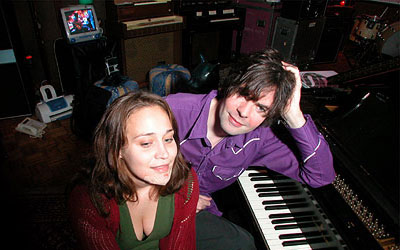
By the late 1990s, Fiona Apple had already made a huge impact with Tidal. But when she began work on her second album, she was searching for something very specific: a way to expand her sound without smoothing out its sharp edges.
Jon Brion was a natural choice. Known for his emotional intelligence in the studio and his ability to translate feeling into arrangement, Brion approached Apple’s songs not as raw material to be “fixed,” but as living things that needed the right environment to grow.
From the beginning, the sessions were intense, exploratory, and deeply hands-on. Apple has described Brion as someone who could hear not just what a song was, but what it could become — sometimes before she herself knew.
As Jon Brion told American Songwriter, working with Fiona was unlike anything he’d experienced:
“She shows up on time, sings three passes of the vocal. It’s amazing. She is completely articulate about her likes and dislikes. She’s also able to describe why, in terms of the song, she doesn’t think something works emotionally.”
When the Pawn… (1999): The album with the longest title in history
The full title is actually a 90-word poem Fiona wrote in response to a cruel Spin magazine article. But forget the novelty — When the Pawn… is one of the most musically sophisticated pop albums ever made.
Brion’s production approach was revolutionary. Instead of the conventional drums-first method, he had Fiona record piano and vocals first, then built entire arrangements around her performances. As he explained,
“Rather than create a simple frame into which a song can fit, I built it a custom frame all around the song.”
The result is an album where every production choice serves the emotional core. When the Pawn… experiments with drum loops, incorporates the Chamberlin (Brion’s signature instrument), and features drummer Matt Chamberlain creating rhythms that feel both organic and programmed.
Critics recognized it immediately. Entertainment Weekly gave it an A, praising both Brion’s production and Apple’s growth: “richer, deeper and stronger than Tidal, in every way.” Rolling Stone called it “more musically complex and melodically advanced” than her debut. In 2020, the album was ranked #108 on Rolling Stone‘s 500 Greatest Albums of All Time.
Tracks like “Fast As You Can” showcase Brion’s ability to match Fiona’s intensity — the production is as restless and volatile as her vocal.
“As soon as she played ‘Fast As You Can,’ I knew exactly what I wanted it to be.”
“People hear certain things on the record and assume I came up with them. Like all the time-changes in ‘Fast As You Can.’ All that stuff was there. All I did was to heighten pre-existing things. In terms of the color changes, I am coordinating all of those, but the rhythms are absolutely Fiona’s.”
“Paper Bag,” meanwhile, demonstrates their gift for sophisticated heartbreak, with Brion’s arrangement making emotional collapse sound almost beautiful.
Fiona Apple’s unreleased album that became a legend: Extraordinary Machine
In spring 2002, Jon Brion was heartbroken. His five-year relationship with comedian Mary Lynn Rajskub had ended during the making of Punch-Drunk Love, which he was scoring for Paul Thomas Anderson. According to reports, he “begged” Fiona Apple to make another album: “I need work that can save me.”
Fiona agreed. Brion approached Epic Records with strict stipulations — including no deadline — which the label accepted. They started recording in June 2002 at Ocean Way Recording, where Fiona played him the first five songs she’d written.
What followed was one of music’s most notorious production sagas.
The Brion Sessions (2002-2003)
Throughout 2002 and into 2003, Brion and Apple worked on Extraordinary Machine. They recorded at Ocean Way, then moved to Cello Studios, then traveled to Abbey Road Studios in London to record strings and orchestration. The album was completed — from Brion’s perspective — in May 2003.
Then… silence.
Release dates came and went: September 2003, then February 2004, then “early 2004.” By fall 2003, Brion and Apple were back in the studio adding “finishing touches,” which only delayed things further. An August 2003 New York Times article about Brion revealed that he’d cried the first time he heard Apple play “Oh Well.”
The leak and the controversy
In October 2004, Entertainment Weekly reported that Epic Records had shelved the album, claiming it contained no obvious singles. Brion clarified to MTV News that Epic had wanted material more like Tidal, “but when confronted by Machine, it’s just not the obvious easy sell to them.”
When asked when the album would be released, Fiona responded: “You’ll probably know before I do.”
Then the Brion Sessions leaked online. Fans organized mail campaigns flooding Sony with support. The internet exploded with debates about whether the label had shelved a masterpiece.
The truth: It was Fiona’s decision
Here’s what most people missed: Fiona herself was unhappy with the Brion Sessions. As Spin later reported: “Fans erroneously thought that Apple’s record label, Epic, had rejected the first version… in reality, according to [producer Mike] Elizondo, Apple was unhappy with the results, and it was her decision to redo the record, not her label’s.”
In August 2005, Epic announced Extraordinary Machine would be released October 4, 2005, extensively reworked by co-producers Mike Elizondo and Brian Kehew. Only two of Brion’s original tracks survived relatively unchanged: “Waltz (Better Than Fine)” and the title track “Extraordinary Machine.”
Two versions, one debate
To this day, fans debate which version is superior. As one Popdose critic wrote: “For the record, I prefer the Brion version.”
The Brion Sessions have a “funky psychotic carnival sound that’s like nothing I’ve ever heard,” according to Treble. His production on “Not About Love” is considered definitive — “unusual aura lifts the song from being just another ‘I don’t love you anymore’ song into something more disturbingly exquisite.”
But as one reviewer noted: “It sounds like Fiona is singing on a Jon Brion album.” And maybe that was the problem. After the deeply collaborative When the Pawn…, Fiona may have wanted more control over her own sound.
The official 2005 release was nominated for a Grammy Award for Best Pop Vocal Album and ranked #49 on Rolling Stone‘s best albums of the 2000s.
The sound Fiona Apple and Jon Brion created together
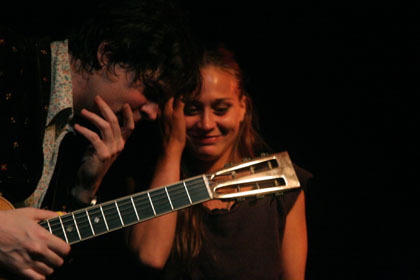
What makes Brion’s production of Fiona Apple’s work so distinctive?
- Custom-built arrangements – Every song gets its own sonic world, built specifically around Fiona’s performance
- Emotional intensity as production choice – If the song is chaotic, the production is chaotic. If it’s tender, every element serves that tenderness
- Vintage keyboards meeting modern beats – Chamberlins, Mellotrons, and pump organs layered with drum loops and programming
- Orchestration that breathes – Strings recorded at Abbey Road don’t just accompany; they comment and react
- Restraint and excess – Knowing when to strip everything away and when to pile it on
As one writer noted, Brion was working with Fiona Apple, Eels, Elliott Smith, and Aimee Mann around the same period. “You can hear a lot of the lushness Brion brought to those records in When the Pawn…“
Beyond the albums: Live magic at Largo and beyond
Despite the Extraordinary Machine controversy, there was no lasting rift between Brion and Apple. They regularly performed together at Largo in Los Angeles, including a joint appearance with Mike Elizondo on bass just before news broke of the official album release.
In 2010, they performed together at “Love and Haiti, Too: A Music Benefit.”
They’ve collaborated on covers, including a memorable version of The Gummy Bears’ “So Sleepy” for charity, which Stereogum called “a jumpy, sweet anti-lullaby.”
In 2011, they shared a stage in LA, hypnotizing the audience with an intimate performance — the first in their years-long history.
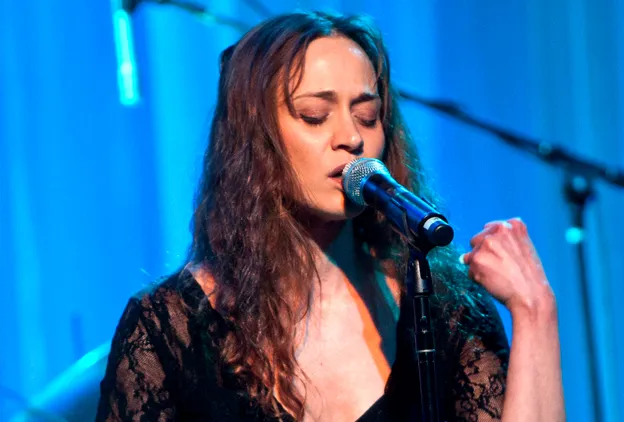
In 2014, both appeared on Blake Mills’ track “Don’t Tell Our Friends About Me” — Apple on background vocals, Brion on tiple. The collaboration proved they could still make magic together, even in supporting roles.
And Fiona Apple has stayed one of my favorite singers-songwriters — look how awesome she is!