Producer · Collaborations
Kanye West & Jon Brion
In March 2005 a film composer who had never made a hip-hop record walked into sessions for an album that was already three-quarters finished, and the album started again.
Kanye West had a problem that most people would like to have. The College Dropout had worked so well that everyone had copied it. The sped-up soul samples that made him were now everywhere, including in his own head, and he did not want to make that record twice. By November 2004 roughly three quarters of the follow-up was recorded. He did not like it.
What he did like was a film score. West had watched Eternal Sunshine of the Spotless Mind in 2004 and gone looking for whoever wrote the music, which led him to Fiona Apple’s When the Pawn…, an album Jon Brion had produced six years earlier. West described the sound he was chasing as a mix of Coldplay, Portishead and Fiona Apple. In March 2005 he brought Brion into the sessions, and the direction of the record changed.
Two people who had no business working together
Brion had never made a hip-hop record. By his own account and West’s, that stopped mattering after a single afternoon in the studio, because neither of them thought in genre. Brion’s description of what they had in common is the most useful thing anyone has said about how the album was made: he recognised someone who saw music architecturally, as a space with a left and right, a front and back, a top and bottom, and who moved things around in it until they sat where they belonged.
The working method was consistent. West would bring a skeleton, a sample, a drum programme, sometimes an unfinished verse. Then he would choose from the instruments Brion brought and played. The album cost around two million dollars and took a little over a year, recorded mostly at Sony Music Studios in New York and the Record Plant in Hollywood.
What he played, and what went wrong while he played it
The instrument list is the part that gives the record its texture and the part that gets misremembered as simply “strings”: celesta, Chamberlin, harpsichord, Chinese bells, berimbau, guitars, pianos, drums, keyboards, brass, and a twenty-piece orchestra that Brion conducted.
Celebration
Conducting that orchestra was harder than it sounds. During “Celebration” the players kept laughing at West’s lyrics, which is a difficult thing to conduct through.
Roses
Brion built keyboard arrangements across the whole track. West then removed the keys and the beat and rebuilt the song so the verses ran on the rhythm of his voice, with Brion’s arrangements returning only in the choruses. Brion later compared the episode, without apparent bitterness, to Prince pulling the bassline out of “When Doves Cry”.
Diamonds from Sierra Leone
The harpsichord on it is used as percussion rather than melody, and the session waited two weeks for the instrument to arrive as a rental. Michel Gondry, who had directed Eternal Sunshine, came by the studio on a day when Brion had a drum kit set up and ended up playing the live drums on the original version.
The credits do not say what he did
This is worth spelling out, because it is the single most common source of confusion about Brion’s role. In the album’s formal personnel list he is credited with string arrangements on three tracks and brass arrangements on two. That is all. The production credits, listed track by track, tell a completely different story.
Note track 19. “Gone” carries a Brion string arrangement and no production credit at all, which is the clearest single example of the gap between what the paperwork records and what is audible.
Reviewing the album in 2005, Robert Christgau called Brion “West’s prize catch” and reckoned his hand was audible on at least half the songs.
The loop closes
West found Brion through a Michel Gondry film. Gondry then wandered into the sessions and played drums on “Diamonds from Sierra Leone”. Then Gondry directed the first video for “Heard ‘Em Say”, the album’s opening song, which Brion co-produced and put together with Adam Levine’s vocal in an afternoon because that was all the studio time Levine had.
Meanwhile, in a room with forty seats
The sessions with Brion ran from March 2005. On 27 April 2005, in the middle of them, he played a solo show at Tonic in New York, and a recording of it survives. The same year he backed Fiona Apple with The Roots, and played “Waterloo Sunset” with Brad Mehldau.
So the year he spent building a number one album is also a year he spent carrying his own instruments into small rooms. Both halves are on this site: Jon Brion live in 2005.
After the orchestra
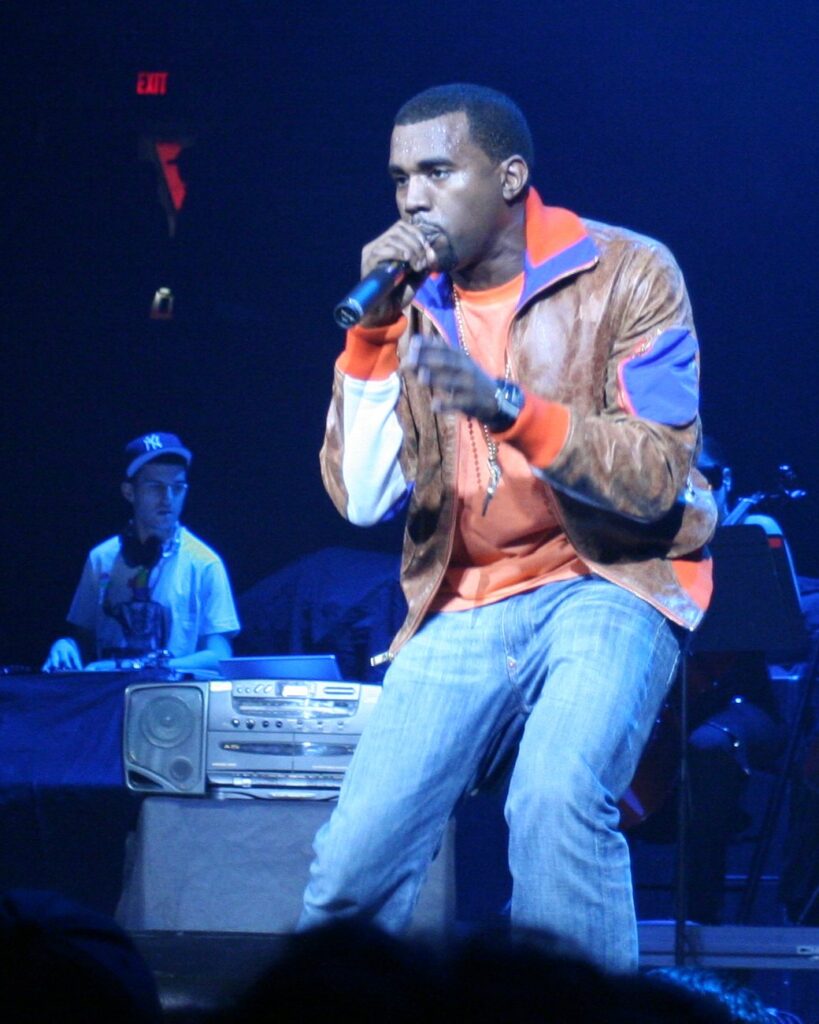

Late Orchestration, recorded at Abbey Road on 21 September 2005 in front of three hundred invited guests, took the Late Registration material on stage with a seventeen-piece all-female string orchestra. It was released the following April.
Then the direction changed. Graduation (2007) was built for stadiums, out of synthesizers, house music and arena rock, after West spent a year touring with U2. There was less for an orchestra to do. Brion appears three times: he produced “Drunk and Hot Girls”, and played keyboards on “I Wonder” and percussion on “Homecoming”. Those are his last credits on a Kanye West album.
Questions people actually ask
Did Jon Brion produce Late Registration?
He co-produced it with Kanye West. Brion holds a production credit on eleven of the album’s seventeen non-skit tracks and is credited as co-executive producer on several of them. West produced the record; Brion is the second name on most of it.
What did Jon Brion actually play on the album?
Strings and brass arrangements, and a long list of instruments chosen track by track: celesta, Chamberlin, harpsichord, Chinese bells, berimbau, guitars, pianos, drums and keyboards. He also conducted the twenty-piece orchestra.
Is Jon Brion on “Gold Digger”?
Yes. He holds a co-production credit on it. The Ray Charles interpolation and Jamie Foxx vocal were already in place; the instruments layered over them are Brion’s contribution.
Did Jon Brion work on Graduation?
On three tracks. He produced “Drunk and Hot Girls”, played keyboards on “I Wonder” and percussion on “Homecoming”. That is the last of his credits on a Kanye West album.
Why did they stop working together?
No public account of a falling-out exists. What the credits show is a change of direction: Graduation moved toward synthesizers and stadium-sized arrangements, and the orchestral approach Brion was brought in for had less to do.
Album facts, personnel and track credits verified 22 September 2026 against Wikipedia’s articles on Late Registration and Graduation, both of which cite the albums’ liner notes, Robert Christgau’s 2005 Village Voice review and Rodrigo Perez’s 2005 MTV interview with Brion. Live performance dates come from this archive’s own year pages. Audio is played through Spotify’s official embed and video through the official upload; nothing is hosted here. Photographs are Creative Commons, credited beneath each image. Production credits elsewhere on this site: the full discography.